

Any structure planned near an airport in India goes through more scrutiny than an ordinary building permit, and for good reason. Aircraft depend on unobstructed approach and departure paths, and something as ordinary as a rooftop water tank or a tall communication mast can quietly become a hazard to landing and departing traffic. That is why the Airports Authority of India requires anyone constructing near an airfield to secure a No Objection Certificate for Height Clearance before construction begins.
The process runs through AAI’s Height Clearance system, known as NOCAS, an online and paperless platform that lets applicants submit height-clearance requests and track their status without visiting an AAI office in person. Because the system involves technical coordinates, elevation data, and safeguarding calculations, most property owners, builders, and developers choose to work with an AAI NOC Consultant for building height clearance in India rather than navigating NOCAS unassisted. This guide walks through what the NOC covers, who needs it, how the application works, and where professional support genuinely helps.
Table of Contents
What Is a Height Clearance NOC in India?
A height clearance NOC in India is a No Objection Certificate issued by AAI confirming that a proposed structure’s height falls within the limits considered safe for aircraft operating near a particular airport. The certificate exists to protect approach and takeoff paths, navigation aids, and general airspace safety around civil airports across the country.
Applications under this NOC cover a wide range of structures, not just residential and commercial buildings. Masts, chimneys, wind turbines, transmission lines, communication towers, and other tall installations located within an airport’s safeguarding zone typically need clearance before construction begins. The permissible height for any given site is not a fixed number; it is calculated using the site’s exact coordinates, ground elevation, and the safeguarding criteria that apply to the nearest airport, which is why two plots only a short distance apart can end up with very different height limits.
Who Needs an AAI Height Clearance NOC?
Not every building in India requires this certificate, and it would be misleading to suggest otherwise. Applicability depends on how close a proposed structure is to a civil airport and whether it falls within that airport’s designated safeguarding zones and applicable regulations. Within those zones, applicants typically include:
- Property owners and developers constructing residential or commercial buildings
- Builders working on high-rise or multi-storey structures
- Telecom companies and infrastructure providers erecting communication masts
- Industrial units installing chimneys or exhaust stacks
- Utility companies laying transmission lines
- Architects and construction consultants preparing height-sensitive project designs
- Infrastructure companies planning wind turbines or similar tall installations
If a project sits anywhere near an airport, the safer approach is to confirm applicability early rather than assume a height clearance NOC in India is unnecessary. Safeguarding zone boundaries and permissible heights vary by location and by airport, and confirming requirements before a design is finalized avoids costly revisions further down the line.
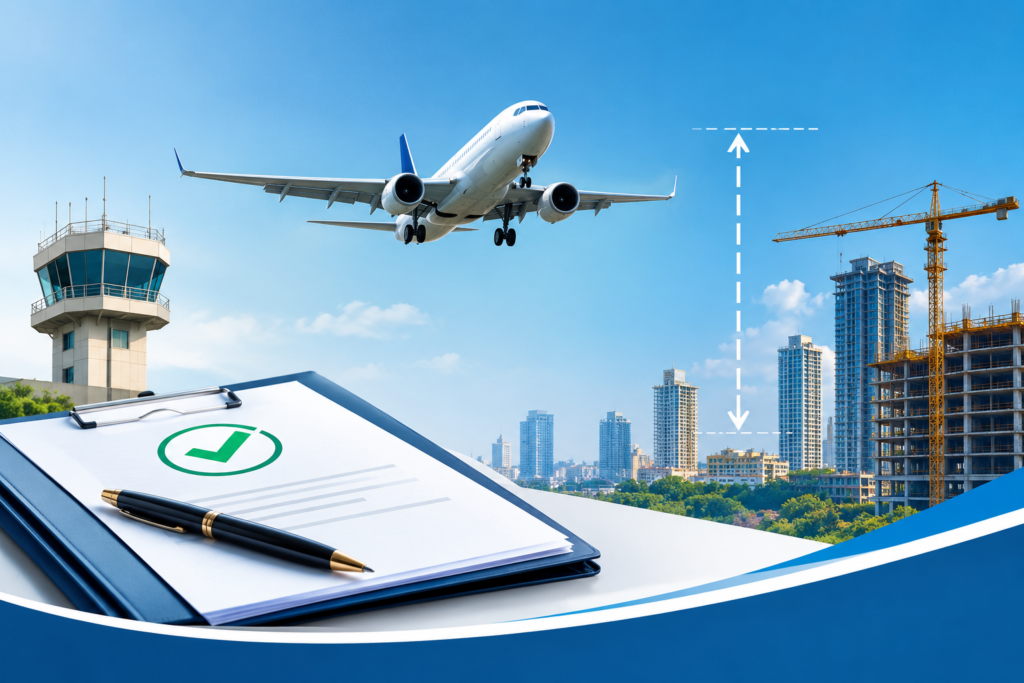
How to Get a No Objection Certificate for Height Clearance: The AAI NOCAS Application Process
The AAI NOCAS application is filed entirely online through AAI’s dedicated height clearance system. While the exact interface can change over time, applicants generally move through the following steps.
Step 1: Register on NOCAS
Visit AAI’s official height clearance portal and register as the owner, lessee, consultant, or authorized applicant for the project. Once registered, activate the account through the verification link sent to the registered email address.
Step 2: Prepare Site Information
Obtain surveyed site coordinates in WGS-84 format from a qualified professional or an agency authorized for this purpose. Obtain accurate site elevation, finalize the proposed top elevation or overall height of the structure, and list every installation or attachment that will sit above the main structure, including overhead water tanks, antennas, lightning arrestors, and lift rooms.
Step 3: Submit the Online Application
Log in to the applicant dashboard, select the option to apply for a new NOC, and enter site and structure details exactly as they appear in the supporting certificates and documents. Before final submission, confirm the site location on the system’s map to rule out any positioning errors.
Step 4: Upload Required Documents
Upload ownership or authorization documents, coordinate and elevation certificates, and any required undertakings. It helps to cross-check that every uploaded document matches the details entered in the application form, since mismatches are one of the more common reasons applications get held up.
Step 5: Track the Application
Once submitted, application status can be monitored directly through the NOCAS dashboard. AAI’s safeguarding process is designed to keep applicants updated electronically as the application moves through review, rather than requiring repeated follow-up calls or visits.
Because each of these steps depends on accurate technical data, many applicants prefer to work with an AAI NOC consultant in India who can prepare the survey inputs correctly the first time, rather than risk delays from avoidable errors.
What Documents and Information Are Required for an AAI NOC for Building Height?
A complete application for an AAI NOC for building height generally needs the following:
- Surveyed WGS-84 site coordinates
- Site elevation, obtained from an authorized professional or agency
- Proposed top elevation of the structure
- Full site and location details
- Ownership or authorization documents for the property
- Required declarations and undertakings
- Supporting survey or certification documents backing the submitted data
Coordinate and elevation figures must meet the accuracy standards AAI expects for its calculations, so it is worth sourcing this data from a professional experienced with height-clearance filings rather than a general-purpose survey. Even data that looks reasonable on paper can fail to meet the precision NOCAS requires.
How Is Building Height Clearance from AAI Determined?
Building height clearance from AAI is not a single number applied nationwide, and it is not something a builder can estimate on their own. NOCAS calculates the permissible top elevation for each application using the surveyed coordinates and site elevation submitted, measured against the safeguarding criteria specific to the nearest airport.
Several factors influence the outcome, including the airport’s runway orientation and classification, the site’s distance and direction from the airport, ground elevation, and any applicable Colour Coded Zoning Map limits for that particular area. Because the calculation depends entirely on the data submitted, accurate survey inputs are essential. Even small errors in coordinates or elevation can meaningfully change the permissible height AAI ultimately returns, which is why many applicants prefer not to leave this stage to guesswork.
Common Mistakes That Delay or Invalidate an AAI Height Clearance NOC
Applicants run into avoidable problems for a handful of recurring reasons:
- Submitting incorrect or imprecise site coordinates
- Reporting inaccurate site elevation
- Entering the wrong proposed height for the structure
- Leaving out rooftop installations such as water tanks, antennas, or lift rooms
- Mismatches between uploaded certificates and the details entered in the application
- Failing to verify the site location on the map before submitting
- Submitting incomplete, outdated, or inconsistent supporting documents
AAI guidance makes clear that incorrect data affecting the permissible-height calculation can affect the validity of an NOC even after it has been issued. That makes accuracy at the application stage far more important than speed, since a quickly filed but flawed application can end up costing more time than a careful one.
Why Work With an AAI NOC Consultant for Building Height Clearance in India
Given how technical the NOCAS process is, most developers and property owners don’t file these applications alone. This is where a firm like Complyn Advisory Services becomes useful for a project team.
Complyn Advisory Services works with property owners, builders, architects, and developers to:
- Assess whether a project falls within an airport’s safeguarding zone and what height limits are likely to apply
- Prepare and organize the coordinate, elevation, and documentation package NOCAS requires
- Support the filing of the AAI NOCAS application from registration through final submission
- Follow up on application status and respond to queries raised during processing
- Advise on revalidation, review, or appeal matters when an NOC needs to be renewed or reconsidered later
It is worth being clear about roles here: AAI is the only authority that issues a height-clearance NOC, and no consultant, including Complyn Advisory Services, can guarantee approval or promise a fixed processing timeline. What an experienced AAI NOC consultant for building height clearance in India can do is reduce the chances of rejection or delay by making sure the application is accurate and complete the first time.
Frequently Asked Questions
What is a No Objection Certificate for Height Clearance?
It is a certificate issued by the Airports Authority of India confirming that a proposed structure’s height complies with the safeguarding limits set to protect aircraft operations near a civil airport.
How do I apply for an AAI height clearance NOC?
Applications are filed online through AAI’s NOCAS platform. Applicants register, submit surveyed site coordinates and elevation, enter structure details, upload supporting documents, and track the application through the dashboard.
What is NOCAS?
NOCAS, or the NOC Application System, is AAI’s online platform for submitting and tracking height-clearance applications without paper filings or in-person visits to an AAI office.
What documents are required for height clearance?
Applicants typically need WGS-84 site coordinates, site elevation data, proposed top elevation, ownership or authorization documents, required undertakings, and supporting survey or certification records.
How is permissible building height calculated?
NOCAS calculates the permissible top elevation using the site’s surveyed coordinates and elevation, measured against the safeguarding criteria for the nearest airport. There is no single height limit that applies everywhere in India.
How can I check my AAI NOC status?
Once an application is submitted, its status can be tracked directly through the applicant’s NOCAS dashboard using the login created at registration.
Can a consultant help with an AAI height clearance application?
Yes. An AAI NOC consultant in India can help assess zone applicability, prepare accurate technical data, manage the NOCAS filing, and follow up during processing, though AAI remains the sole authority responsible for approval.
What happens if an AAI NOC application is rejected?
A rejected or invalidated application generally needs to be reviewed, corrected, and resubmitted, or in some cases taken up through AAI’s revalidation or appeal process, depending on the specific reason for rejection.
Get Expert Help From an AAI NOC Consultant for Building Height Clearance in India
Height-clearance rules exist to keep aircraft operations safe, and getting the NOCAS application right the first time saves both time and money. Whether the project involves a building, a mast, a chimney, or any other structure near an airport, Complyn Advisory Services can help assess what applies to the site and support the filing from start to finish.
Need an AAI NOC Consultant for building height clearance in India?
Reach out to Complyn Advisory Services today for professional guidance on your AAI height-clearance NOC application, from initial site assessment through to final submission and follow-up.