

If your construction project is located within the airport influence zone of Chennai, you are legally required to obtain a No Objection Certificate from the Airports Authority of India before proceeding beyond the permissible height threshold. Understanding the AAI NOC requirements in Chennai is essential for developers, builders, and project owners working in neighbourhoods such as Meenambakkam, Pallavaram, Chromepet, Adyar, Guindy, and St. Thomas Mount, all of which fall within or are adjacent to the protected airspace corridors of Chennai International Airport.
Whether you are constructing a residential apartment block, a commercial office tower, an industrial facility, or a telecom mast, this guide covers everything you need to know about AAI NOC requirements Chennai: the six core conditions for approval, the aviation clearance documents required, the specific height restriction zones around the airport, common mistakes that cause rejection, and practical tips to keep your India height approval on track.
Table of Contents
Introduction to AAI NOC in Chennai
The AAI NOC is a formal clearance issued by the Airports Authority of India confirming that a proposed structure does not penetrate the Obstacle Limitation Surface (OLS) of a licensed aerodrome. For Chennai, the reference aerodrome is Chennai International Airport, one of the four major international airports in India. Its OLS covers a substantial radius across the city and its southern suburbs, making the AAI NOC requirements in Chennai applicable to a significant volume of construction activity every year.
The legal basis for this requirement comes from the Aircraft Act 1934 and Aircraft Rules 1937, which empower AAI to regulate structures in the vicinity of airports. The OLS is defined for each aerodrome and specifies the maximum permissible height at any given point around the runway, approach paths, and transitional surfaces. No building can legally exceed these limits without prior clearance, regardless of whether local planning authority approval has already been obtained.
Why Building Height Clearance is Important for Chennai Projects
The consequences of proceeding without a valid Chennai building NOC checklist compliance are serious. AAI has the legal authority to require demolition of structures that violate height restrictions, and local planning bodies including CMDA and the Chennai Corporation, are increasingly requiring AAI clearance as a condition for issuing building completion and occupation certificates.
For residential developers in southern Chennai localities, the financial and reputational risk of a height violation is substantial. Commercial and industrial project owners face similar exposure, particularly as Chennai continues to expand southward along the Old Mahabalipuram Road corridor and toward areas that are progressively coming under stricter OLS scrutiny. An early and accurate assessment of the AAI NOC requirements Chennai applicable to your site prevents these outcomes before construction begins.
Top 6 Requirements for AAI NOC Building Height Clearance in Chennai
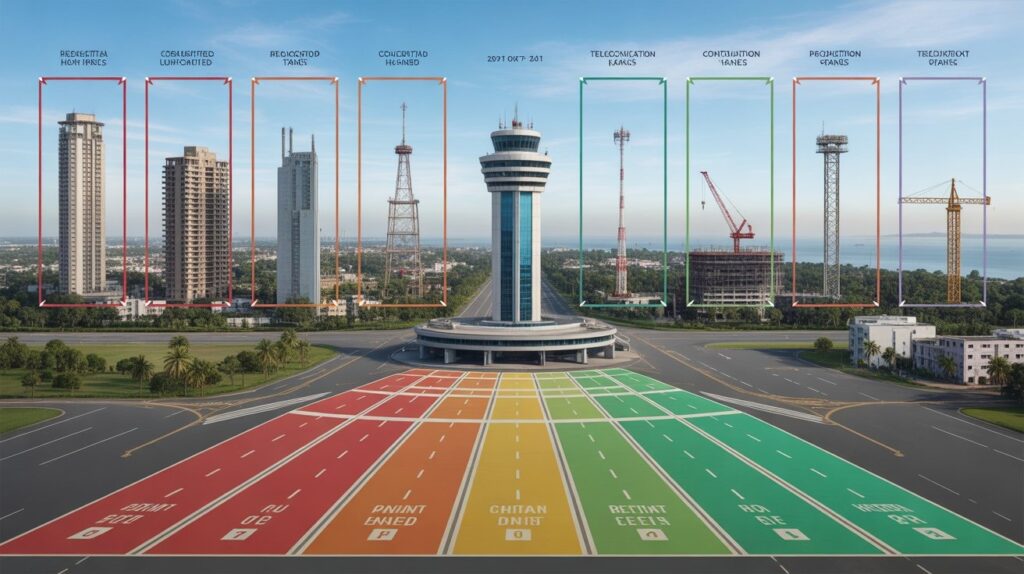
The following six requirements form the foundation of a compliant and complete AAI NOC application for any project in the Chennai airport influence zone.
Requirement 1: GPS-Verified Site Coordinates
The most fundamental AAI NOC requirements in Chennai condition is the submission of accurate GPS-verified site coordinates in the WGS84 decimal degrees format. AAI evaluates your proposed structure against the OLS using these coordinates as the reference point. Coordinates derived from town survey maps, Google Maps, or satellite imagery are not acceptable because they carry positional errors that can misrepresent the site’s relationship to the protected airspace. A certified GPS field survey must be conducted and the results submitted in the format specified by the AAI online NOC portal.
Requirement 2: AMSL-Converted Height Data
AAI evaluates structures against the OLS using height expressed in metres above Mean Sea Level (AMSL), not above ground level (AGL). This is the second most critical AAI NOC requirement in Chennai and the most common source of rejection. Applicants must convert the proposed structure height from AGL to AMSL by adding the ground elevation of the site. For Chennai sites, which are generally at low elevation but vary across nodes, this conversion must be performed precisely using certified elevation data. All height figures submitted must reflect the highest point of the structure including rooftop installations such as water tanks, lift machine rooms, and antennae.
Requirement 3: Complete Architectural and Structural Drawings
A full set of architectural and structural drawings is mandatory as part of the aviation clearance documents package. These must include building elevation drawings for all facades, floor-wise layout plans, and clear notation of rooftop structures. The drawings must be prepared by a licensed architect and must reflect the true proposed height including all appurtenances. Submissions that omit rooftop elements or show inconsistencies between the stated height and the drawings are returned for revision, causing delays.
Requirement 4: Complyn Advisory Services
Complyn Advisory Services identifies the fourth critical requirement as having valid and complete land and ownership documentation. AAI requires proof that the applicant has legal authority over the site. This means submitting a registered sale deed, a property card, a lease agreement registered with the sub-registrar, or an allotment letter from the relevant authority. Unregistered or disputed land documents are a frequent cause of application hold. For commercial and industrial projects in Chennai’s SIPCOT, TIDCO, or CMDA-allotted zones, the applicable allotment documents must be specifically formatted to match AAI’s submission requirements.
Requirement 5: Local Planning Authority Approval Reference
Applicants must provide proof of engagement with the local planning authority as part of the India height approval process. For Chennai projects, this means submitting either the building plan approval issued by CMDA (Chennai Metropolitan Development Authority) or the Chennai Corporation, or at a minimum, the application acknowledgement number from the respective body. AAI does not substitute for local approvals, but it requires confirmation that the project is in the formal approval pipeline with the relevant municipal or metropolitan planning body.
Requirement 6: Applicant Identity and Entity Documents
The final core element of AAI NOC requirements Chennai compliance is the submission of complete applicant identity and entity documentation. For individual applicants, this means government-issued photo identity and address proof. For companies, this means the certificate of incorporation, a copy of the board resolution authorising the signatory, and the PAN of the company. For partnership firms and LLPs, partnership deeds and designated partner certificates are required. Incomplete entity documentation is a common cause of application rejection at the initial screening stage.
Documents Required for AAI NOC in Chennai
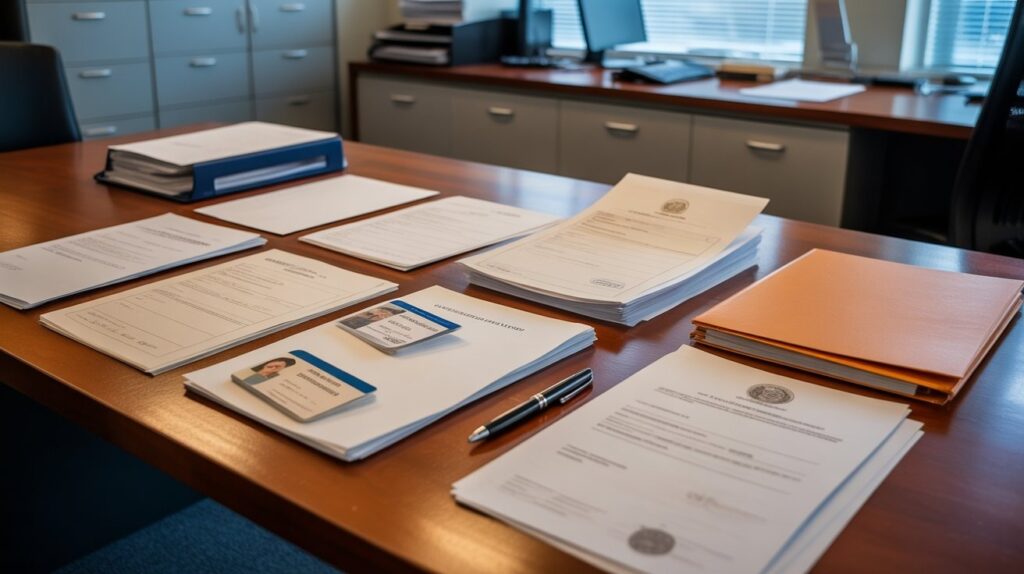
A complete aviation clearance documents package for a Chennai airport height clearance application includes the following:
- GPS-surveyed WGS84 coordinates: Decimal degree format, certified by a licensed surveyor.
- AMSL height calculation sheet: Showing the conversion methodology, ground elevation source, and final AMSL figure for the highest structural point.
- Architectural elevation drawings: Signed and stamped by a licensed architect, showing all facades and rooftop elements.
- Structural drawings: Floor-wise layout plans consistent with the stated building height.
- Land documents: Registered sale deed, property card, or allotment letter as applicable.
- Local planning approval: CMDA or Corporation of Chennai building plan approval or application reference.
- Applicant KYC documents: Individual identity proof or company incorporation and authorisation documents.
- No Objection from local body: Where applicable, a letter from CMDA, SIPCOT, or the relevant development authority.
Need Help with AAI NOC in Chennai?
Expert guidance on documentation, portal submission, and approval for building height clearance near Chennai airport zones.
Consult Complyn Advisory Services TodayChennai Airport Height Restriction Zones
Chennai International Airport’s OLS creates multiple layers of height restriction across a wide belt of the city. The zones most directly affected include:
- Meenambakkam and Pallavaram: Located closest to the runway threshold and subject to the most stringent height limits. Even low-rise residential construction in these areas requires OLS assessment.
- Chromepet and Tambaram: Falling within the approach and take-off climb surfaces, these areas permit moderate heights but require careful AMSL calculation before any multi-storey project proceeds.
- Adyar and Guindy: Subject to transitional surface restrictions. Commercial and mixed-use towers in these localities frequently require Chennai building NOC checklist compliance.
- St. Thomas Mount and Alandur: Proximity to the airport boundary makes these areas subject to the conical surface height limit, which restricts structures to a progressively rising ceiling as distance from the airport increases.
- Old Mahabalipuram Road (OMR) belt: As development moves southward, newer nodes along OMR are being brought within OLS scrutiny zones, making early feasibility checks essential for any high-rise project in this corridor.
The specific permissible height at your site depends on its precise coordinates relative to the runway reference point and the applicable OLS surface. There is no single height limit that applies across all of Chennai. Each project must be assessed individually against the airport-specific OLS chart, which is why professional India height approval advisory is recommended for all projects in the city.
Common Mistakes Leading to AAI NOC Rejection in Chennai

Understanding the most frequent errors helps ensure your AAI NOC requirements in Chennai avoid them. Working with an experienced AAI NOC Consultant for Building Height Clearance in Chennai can also help reduce approval delays and technical rejections:
- Using map-derived coordinates: Google Maps or survey department coordinates contain positioning offsets that AAI’s system will flag. Only GPS-surveyed WGS84 data is accepted.
- Submitting AGL height only: Applications that list height above ground level without an AMSL-converted figure are returned at the first screening stage.
- Omitting rooftop structures: Water tanks, elevator machine rooms, parapet walls, AC condensers, and antennae must all be included in the maximum height declaration.
- Inconsistent drawings: Elevation drawings that show a different height than the stated figure cause automatic queries and delays.
- Uploading unregistered land documents: Agreement to sell or unregistered lease agreements do not satisfy AAI’s land authority requirement.
- Missing local body reference: Applications submitted without any CMDA or Corporation acknowledgement are incomplete by AAI’s definition and placed on hold.
Quick Checklist Before Applying for AAI NOC in Chennai
Use this Chennai building NOC checklist to confirm your application is complete before submission:
| Checklist Item | Done? |
| GPS survey completed and WGS84 coordinates obtained | [ ] |
| Ground elevation sourced and AMSL height calculated | [ ] |
| Architectural elevation drawings prepared by a licensed architect | [ ] |
| Rooftop structures (tanks, rooms, antennae) are included in height | [ ] |
| Structural drawings consistent with the stated height | [ ] |
| Registered land documents (sale deed/property card/allotment letter) are ready | [ ] |
| CMDA or Corporation building plan approval or reference number obtained | [ ] |
| Applicant KYC or company incorporation documents compiled | [ ] |
| Local body NOC obtained where applicable (SIPCOT / TIDCO / CMDA) | [ ] |
| All documents converted to AAI-specified file format for portal upload | [ ] |
| Application reviewed by a qualified aviation NOC consultant | [ ] |
Step-by-Step AAI NOC Application Process for Chennai
The India height approval process for Chennai projects follows these stages:
- OLS feasibility assessment: Plot your GPS-verified site coordinates against the Chennai airport OLS chart to determine whether your proposed height requires NOC filing and which OLS surface applies.
- GPS survey and AMSL conversion: Commission a certified GPS survey. Use the output to calculate the AMSL-converted height for the highest point of the proposed structure.
- Document compilation: Prepare the full aviation clearance documents package including drawings, land records, local authority reference, and applicant documents.
- AAI portal registration: Create an account on the AAI online NOC portal, initiate a new application, and enter all site and structure data accurately.
- Document upload and submission: Upload all documents in the required formats and submit the application for technical review.
- Query monitoring and response: Track the application status on the portal. Respond to technical queries from AAI’s review team promptly and with accurate supporting data.
- NOC receipt and safekeeping: On approval, the NOC is issued digitally. Store it securely and note the validity period. Initiate renewal before expiry if construction has not commenced.
Tips for Faster AAI NOC Approval in Chennai
- Start early: Initiate the OLS feasibility check and GPS survey at the design stage, before finalising the structural plan. This allows height adjustments without rework.
- Use certified surveyors: Engage a licensed GPS surveyor with experience in aviation-related surveys to ensure coordinate accuracy and AMSL data reliability.
- Match all height figures: Ensure the height stated in the application form, the drawings, and the AMSL calculation sheet are identical. Any inconsistency triggers a query.
- Prepare for the complete package upfront: Do not submit a partial application expecting to add documents later. AAI processes complete submissions first.
- Engage a professional: Working with an experienced AAI NOC requirements Chennai consultant from the outset is the single most effective way to reduce rejection risk and shorten approval timelines.
Need Help with AAI NOC in Chennai?
Expert guidance on documentation, portal submission, and approval for building height clearance near Chennai airport zones.
Consult Complyn Advisory Services TodayFrequently Asked Questions
What is the primary AAI NOC requirement for a building in Chennai?
The primary AAI NOC requirements for Chennai condition is submission of GPS-verified WGS84 coordinates and the AMSL-converted height of the proposed structure for OLS assessment.
Which Chennai localities fall within the airport height restriction zone?
Meenambakkam, Pallavaram, Chromepet, Guindy, Adyar, St. Thomas Mount, and Alandur are among the areas most directly within the Chennai airport OLS zone requiring India height approval scrutiny.
Can a Chennai building plan approval from CMDA replace the AAI NOC?
No, CMDA approval and the AAI NOC are independent requirements. A building may receive CMDA approval and still be refused aviation clearance documents clearance if it intrudes into the airport’s protected airspace.
How long does the AAI NOC approval process take in Chennai?
A complete and accurate submission typically takes 30 to 90 days for AAI review. Incomplete applications or those attracting technical queries can take significantly longer.
What happens if construction starts without an AAI NOC in Chennai?
Constructing without a valid Chennai building NOC checklist clearance can result in AAI-directed stop-work notices, legal proceedings under the Aircraft Act 1934, and mandatory structural modification or demolition in cases of serious OLS violation.
Conclusion
Meeting the AAI NOC requirements in Chennai is not a formality that can be deferred or overlooked. For any residential or commercial project located within the Chennai International Airport influence zone, building height clearance is a statutory requirement that must be addressed before the structure rises above the permissible OLS threshold. The six core requirements covered in this guide, from GPS-verified coordinates and AMSL height data to complete aviation clearance documents and local authority references, form the complete foundation of a compliant and approvable application.Getting the documentation right the first time, understanding the Chennai-specific height restriction zones, and avoiding the common mistakes that cause rejection will save developers significant time and cost. For professional guidance on the complete India height approval process and all aspects of Chennai building NOC checklist compliance, Complyn Advisory Services offers end-to-end support for residential, commercial, and industrial projects across Chennai and the wider Tamil Nadu region.