

Think about how many vendors your business works with. Payroll processors, cloud storage providers, logistics partners, marketing agencies, IT service companies. Each one of them, at some point, touches data that belongs to your business or your customers. And in most cases, that relationship is governed by a contract. But here is the uncomfortable truth: most of those contracts say very little about what happens to the data once it leaves your hands. That gap is exactly where Data Protection in Vendor Agreements becomes not just important but absolutely critical.
A vendor relationship without proper data protection terms is essentially a handshake agreement on one of the most sensitive aspects of your business. You are trusting another organisation with your data and hoping things go well. That is not a strategy. That is a risk.
Over the past few years, data breaches linked to third-party vendors have become alarmingly common. In 2023, research indicated that nearly 60 percent of data breaches globally involved a third-party vendor in some capacity. Indian businesses, as they scale and outsource more functions, are increasingly exposed to this exact risk.
This article breaks down why vendor data agreements matter, what they need to include, and how to make sure your contracts are actually protecting you.
Table of Contents
The Real Risk Sitting Inside Your Vendor Relationships
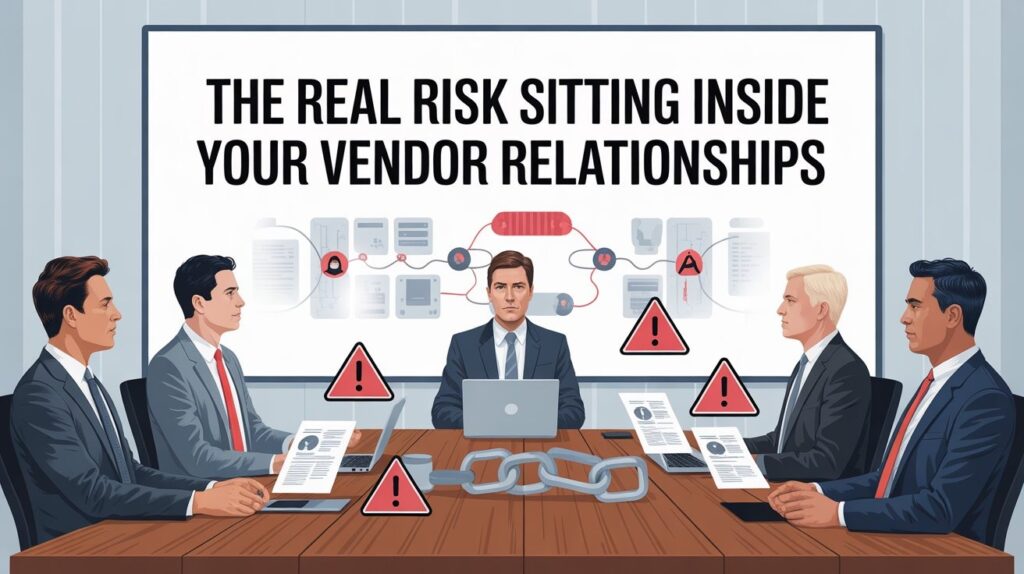
Data Does Not Stay Where You Expect It To
Most business owners and compliance teams focus on internal data security. Firewalls, access controls, employee training. These are necessary. But the moment you share data with a vendor, your internal controls mean nothing at the vendor’s end.
Your payroll vendor stores employee salary details, bank account numbers, and tax information. Your logistics partner holds customer delivery addresses and order histories. Your CRM agency has access to your entire client database. Each of these relationships carries significant data exposure, and unless your contract addresses it directly, you have very little legal standing if something goes wrong.
Vendor Breaches Have Direct Business Consequences
When a vendor suffers a data breach, the reputational and financial damage often falls on the business that hired them, not just the vendor itself. Customers do not distinguish between your company and your vendor. They just know their data was compromised. And in regulated sectors like banking, healthcare, and fintech, regulatory consequences for inadequate vendor oversight can be severe.
This is why vendor data protection clauses need to be treated as non-negotiable contract terms, not optional add-ons. They define who is responsible, what standards the vendor must meet, and what happens when things go wrong.
What the Law Expects From Indian Businesses
The DPDP Act and What It Means for Vendor Contracts
India’s Digital Personal Data Protection Act, 2023, commonly known as the DPDP Act, changes the compliance landscape significantly. While India does not have a regulation identical to the European GDPR, the DPDP Act is often referred to as India’s GDPR India equivalent compliance framework because it introduces similar obligations around data processing, consent, and accountability.
Under the DPDP Act, organisations that collect and process personal data are classified as Data Fiduciaries. When they engage vendors to process that data on their behalf, those vendors become Data Processors. The critical point is that the Data Fiduciary remains accountable for how the Data Processor handles the data.
In plain terms, if your vendor misuses or loses customer data, your business can still face regulatory scrutiny even if the vendor was the one who made the mistake. The law expects you to have imposed appropriate contractual controls on the vendor from the start.
What This Means Practically
For Indian businesses, GDPR India equivalent compliance under the DPDP Act means that vendor agreements must now reflect data processing obligations explicitly. This is no longer a best practice. It is becoming a legal expectation that regulators will examine when investigating complaints or breaches.
Businesses in sectors like banking, insurance, and healthcare are already subject to sector-specific data protection guidelines from regulators like RBI, IRDAI, and CDSCO. For them, inadequate vendor data agreements can result in both sectoral regulatory action and consequences under the DPDP framework.
Core Clauses That Every Vendor Data Agreement Needs
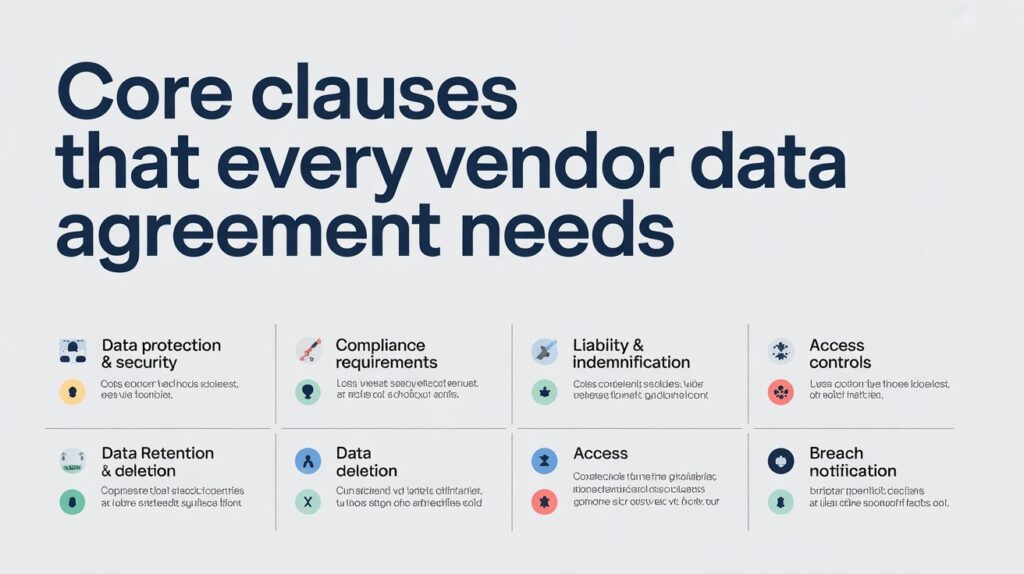
Strong Data Protection in Vendor Agreements does not happen by accident. It requires deliberate drafting of specific clauses that address the full lifecycle of data within the vendor relationship. Here are the clauses that every well-structured vendor contract needs to include.
Purpose Limitation Clause
This clause restricts the vendor from using your data for any purpose other than what is explicitly defined in the contract. If you are sharing customer contact details for the purpose of delivery notifications, the vendor should not be allowed to use that data for its own marketing or share it with sub-vendors without your consent.
Purpose limitation is one of the most violated data protection principles in vendor relationships, often not because of malicious intent but because the contract never specified restrictions clearly enough.
Data Security Standards Clause
This is where data security contract clauses become specific. The contract should define the minimum security standards the vendor must maintain. This includes encryption standards for data at rest and in transit, access control policies, multi-factor authentication requirements, regular security audits, and incident response procedures.
Vague language like “the vendor will maintain appropriate security measures” is not enough. Data security contract clauses should name specific standards, such as ISO 27001 certification, SOC 2 compliance, or alignment with CERT-In guidelines for Indian vendors. The more specific the clause, the more enforceable it becomes.
Sub-Processing Restrictions
Many vendors use their own sub-vendors. Your data may pass through two or three organisations before a task is completed. Your contract needs to address this explicitly. Either prohibit sub-processing entirely or require the vendor to seek your written approval before engaging sub-processors, and to flow down the same data protection obligations to them.
Data Breach Notification Clause
This clause defines the vendor’s obligation to notify you if a data breach occurs, and it specifies the timeline for that notification. International standards and India’s CERT-In directive both require breach notifications within 6 hours of detection for certain categories of incidents. Your vendor contract should mirror or exceed this expectation.
The clause should also specify what the notification must contain, who it must be sent to, and what remediation steps the vendor is expected to take immediately upon detecting a breach.
Data Retention and Deletion Clause
When the vendor relationship ends, what happens to your data? This clause ensures the vendor cannot retain your data beyond the agreed period and must either return it to you or permanently delete it, with written confirmation of deletion provided within a defined timeframe. Without this clause, your data can sit in a vendor’s systems indefinitely.
Audit Rights Clause
This gives you the right to audit the vendor’s data handling practices, either directly or through a third-party auditor. Many organisations resist this clause during negotiation. That resistance itself is a signal worth paying attention to.
Contract Risk Management for Data Privacy
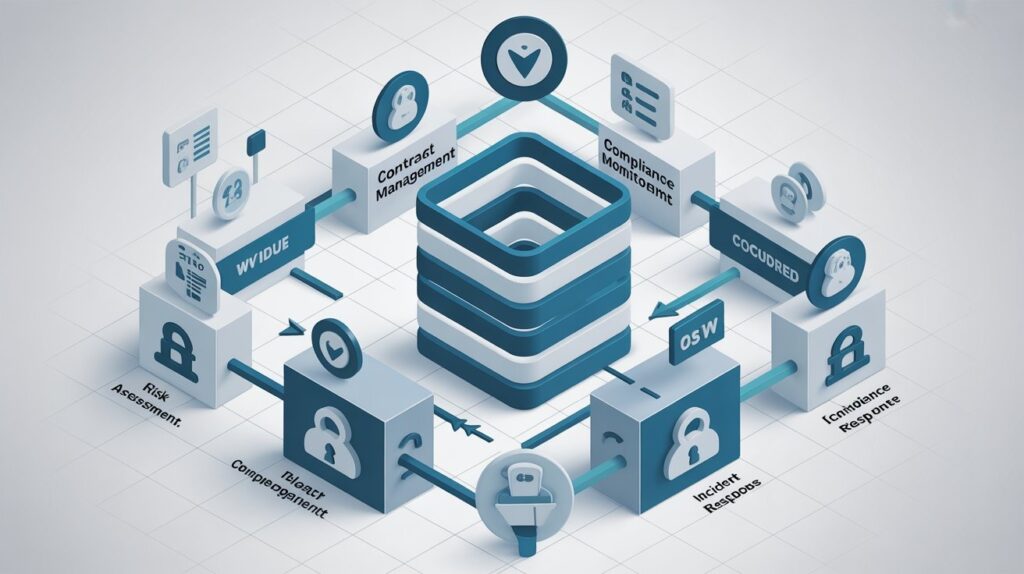
Looking at vendor data agreements in isolation is not enough. They need to sit within a broader contract risk management data privacy framework that your organisation applies consistently across all vendor relationships.
Tiering Your Vendors by Data Risk
Not every vendor carries the same level of data risk. A vendor that processes only anonymised operational data is very different from one that handles personally identifiable information or payment data. A practical risk management approach involves tiering vendors based on the type and volume of data they access.
High-risk vendors should face the most rigorous contract risk management data privacy requirements: full data processing agreements, mandatory audits, security certifications, and regular compliance reviews. Low-risk vendors may need lighter contractual controls, but they still need something in writing.
Pre-Contract Due Diligence
Before signing any agreement, conduct a data protection assessment of the vendor. This means reviewing their privacy policy, asking about their security certifications, understanding where they store data and under what jurisdiction, and checking whether they have experienced any significant data incidents in the past.
This due diligence step is often skipped, especially when procurement is moving fast. But the time you spend assessing a vendor before contracting is always less than the time you spend managing a breach aftermath.
Ongoing Monitoring Is Not Optional
Signing a vendor agreement with strong vendor compliance agreements is only the beginning. Compliance is not a one-time event. It requires ongoing monitoring: annual security reviews, renewal of certifications, verification that the vendor’s sub-processors have not changed, and checking that data retention policies are being followed in practice.
Many organisations treat vendor compliance agreements as a paperwork exercise. They get the contract signed and move on. But a vendor who was fully compliant at the time of signing may look very different 18 months later if their internal controls have weakened or their team has changed.
Vendor Data Protection Clauses: Common Mistakes to Avoid
Even organisations that take vendor data protection clauses seriously often make mistakes that leave them exposed. Here are the most common ones.
• Using standard templates without customisation: A generic NDA is not a data processing agreement. Templates need to be tailored to the specific data shared, the specific vendor, and the specific regulatory requirements applicable to your industry.
• Failing to define what counts as personal data in the contract: Contracts that are vague about what data is covered create enforcement problems if something goes wrong.
• Not addressing international data transfers: If your vendor stores or processes data outside India, your contract needs to address cross-border data transfer obligations under the DPDP Act.
• Omitting liability caps and indemnity clauses: If a vendor breach causes you financial harm, your ability to recover depends on what the contract says about liability. Many businesses discover too late that the vendor’s liability is capped at the contract value, which is rarely enough to cover a breach-related loss.
• Not reviewing vendor agreements at renewal: Data protection laws evolve. A contract that was adequate two years ago may no longer meet current regulatory expectations. Every renewal is an opportunity to update the data protection terms.
Building a Vendor Data Protection Framework That Actually Works
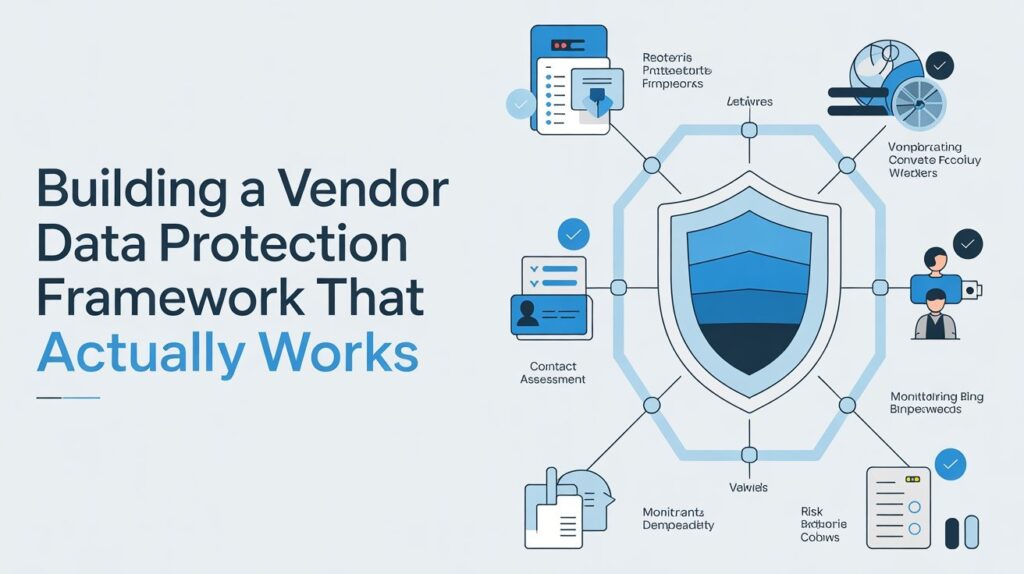
Getting vendor data agreements right is not just a legal task. It is an operational one. It requires coordination between your legal, procurement, IT, and compliance teams. Each team has a role to play and the contract is the document that ties all of their responsibilities together.
Start by creating a standard vendor data protection agreement template that your legal team has pre-approved. This saves time during procurement and ensures consistency. Then train your procurement team on the basics: what questions to ask vendors, what red flags to watch for, and when to escalate to the legal or compliance team.
Create a vendor data register that tracks what data each vendor holds, what their contract terms say, when the agreement expires, and when the last compliance review was conducted. This register becomes the foundation for ongoing monitoring and keeps your organisation audit-ready.
Final Thoughts
Data protection is not just an IT problem. It is a contractual one. Every vendor relationship that involves data creates risk, and the contract is your primary tool for managing that risk. Weak or vague Data Protection in Vendor Agreements leaves your business exposed to regulatory consequences, reputational damage, and financial loss, all of which can flow from a breach that originated not within your own systems but in a vendor’s.
The good news is that with the right approach, these risks are manageable. Clear clauses, structured due diligence, ongoing monitoring, and regular contract reviews can turn a vulnerability into a strength.
Comply Advisory Services supports organisations across industries in structuring vendor contracts that reflect current data protection obligations, with practical, clause-level advisory that goes beyond generic legal templates. If your current vendor agreements need a review or you are building a new vendor onboarding process, reach out to Complyn Advisory Services to explore how structured contract advisory can protect your business.
Frequently Asked Questions (FAQs)
Is a standard NDA enough to protect data shared with a vendor in India?
No, a standard NDA typically covers confidentiality but does not address data processing obligations, security standards, breach notification timelines, or data deletion requirements, all of which are essential for adequate data protection in a vendor relationship.
Does India’s DPDP Act require businesses to have written data protection agreements with all vendors?
The DPDP Act holds Data Fiduciaries accountable for the actions of their Data Processors, which means businesses are expected to impose appropriate contractual controls on vendors who process personal data on their behalf, making written agreements a practical and regulatory necessity.
What should a vendor data breach notification clause specify?
A vendor data breach notification clause should specify the maximum timeframe for notification after detection, the minimum information that must be included in the notification, the designated contact at your organisation who must be informed, and the immediate remediation steps the vendor is required to take.
How often should vendor data protection agreements be reviewed?
Vendor data protection agreements should be reviewed at least annually and also at every contract renewal, as data protection laws evolve and the nature of a vendor relationship can change significantly over 12 to 24 months.
Can a vendor’s liability for a data breach be limited in the contract?
Yes, most vendor contracts include liability caps, often linked to the contract value, which is why it is critical during negotiation to push for liability terms that reflect the actual potential harm of a data breach rather than accepting standard vendor-proposed caps.